

Knee pain rarely arrives with a clear story. There was no fall and no twist. The stairs just started to hurt.
That is the common case, and the one people put off. Knee pain is not one problem. It is at least eight, each needing a different first move.
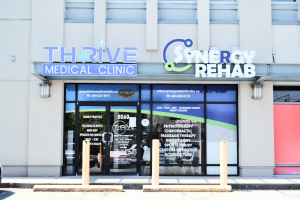
Our South Surrey clinic at 2388 156 Street treats knee pain. No referral needed in BC. Call (604) 385-5855 or book an assessment.
The short answer
- Where the pain sits matters more than how bad it feels. Front, inner, outer and behind point different ways.
- Dull, aching front knee pain that is worse on stairs is the most common pattern we see.
- Sharp, stabbing pain just below the kneecap after a jump or a run usually means the tendon.
- Deep pain that catches or locks when you twist points at the meniscus.
- A knee that gives way, locks solid, or swells fast within an hour needs a doctor, not a wait.
- In BC you do not need a referral to see a physiotherapist.
Eight causes of knee pain, and what each one feels like
Find the one that matches yours. HealthLink BC groups knee problems into sudden injuries, overuse and other conditions, and all three turn up below.
Dull, aching pain at the front of the knee, worse on stairs
This is patellofemoral pain, which HealthLink BC describes as front-of-knee pain. It builds over weeks, not on one day.
Stairs, hills and long drives aggravate it. Hip and thigh strength usually matter more than the knee itself.
Sharp, stabbing pain just below the kneecap
Point to it with one finger and it is probably the patellar tendon. Jumping, running and sudden training increases load it hard.
It often eases once you warm up, then bites afterwards. That pattern is typical of tendon pain, and it misleads people into pushing through.
Deep pain that catches, clicks or locks when you twist
HealthLink BC calls the meniscus a rubbery cushion in the knee joint. Twisting on a planted foot is the usual mechanism.
Catching and locking are the giveaways. Our post on healing a meniscus tear with physiotherapy covers what follows.
Burning pain on the outside of the knee after a long run or ride
Iliotibial band syndrome is irritation of the band down the outer thigh. It shows up at a predictable distance, not at the start.
Downhill running makes it worse. Load management and hip strengthening do most of the work.
Aching pain on the inner side of the knee
Inner knee pain has several sources. HealthLink BC names the medial collateral ligament as the most often injured one, usually after a blow from the side.
Without a clear injury, the inner knee can still ache from load alone. Our post on knee MCL injuries explains the difference.
Stiff, constant aching that is worst first thing in the morning
Osteoarthritis is the pattern. HealthLink BC notes it often occurs at the site of an old injury.
It is common and treatable. The Canadian Institute for Health Information reports 83,700 knee replacements due to osteoarthritis in Canada each year. Most people never reach that point.
Swollen, throbbing pain right over the kneecap
Bursitis inflames the fluid sacs that cushion the knee. Kneeling trades, flooring and gardening provoke it.
The swelling sits on top of the kneecap, not inside the joint. Changing how you kneel is usually step one.
Radiating pain with no tender spot on the knee itself
Sometimes the knee is the messenger, not the problem. HealthLink BC lists a pinched nerve or a hip problem as causes of referred knee pain.
Press around the joint and nothing hurts. That sends the assessment up to the hip and the low back.

A 60 second self-check before you book
None of this diagnoses anything. It tells you what to say when you call.
See a doctor first if any of these apply
HealthLink BC lists these among the reasons to seek medical care for a knee problem.
- Pain or swelling that is new, or that keeps getting worse
- Signs of infection, such as redness, warmth, pus or a fever
- Numbness, tingling, or skin that looks pale or feels cool below the knee
- Movement or strength in the leg that is getting worse
- A kneecap or knee joint that is visibly out of place
- A leg that is blue, very pale or cold compared with the other one
For an emergency, call 9-1-1.
What a physiotherapist checks at the first visit
A knee assessment is mostly questions and movement. It takes about an hour, and treatment starts the same visit.
| What we check | Why it matters |
|---|---|
| Where you point | Front, inner, outer and behind narrow the list before anything is touched |
| Ligament and meniscus tests | Tells us whether this is a tissue that needs protecting or loading |
| Hip and ankle strength | HealthLink BC notes strong core and hip muscles help control knee pain |
| How you squat, step and land | Shows the movement that keeps re-loading the painful tissue |
| What you want to get back to | Skiing in December and a flat dog walk are not the same goal |
What treatment usually involves
HealthLink BC says physiotherapy for a painful knee almost always includes exercise. Stretching, strengthening, core work and walking are on its list.
It also names manual therapy, heat and cold, and bracing where it helps. We use the same toolkit in South Surrey.
HealthLink BC gives a usable starting dose. Hold a quad set or a straight leg raise for about 6 seconds, rest up to 10 seconds, and repeat 8 to 12 times. On a bike, start with 5 to 10 minutes at little resistance and build towards 20 to 30 without pain.
That progression is what active rehabilitation and kinesiology are for. Hands-on physiotherapy, massage therapy and intramuscular stimulation handle the stiffness around it.
Talk to a physiotherapist before starting, and stop if an exercise hurts. That is HealthLink BC’s own advice.

Skiing, and why late October is the sensible time
Whistler, Cypress, Grouse and Seymour all open within weeks of each other. A knee that aches on stairs in October will not enjoy a mogul field in December.
Our guide to five essential ski exercises covers the pre-season work. Start before the pain, not after.
Who pays for knee physiotherapy in BC
You do not need a referral. The Physiotherapy Association of BC states that you do not need one from a physician or nurse practitioner.
If the knee was hurt in a crash, ICBC pre-approves 25 physiotherapy treatments in the first 12 weeks, plus 12 with a kinesiologist. If it happened at work, our post on WorkSafeBC physiotherapy coverage explains that route. Otherwise most extended health plans cover it, and we direct bill.
Frequently asked questions
What causes knee pain without an injury?
Most often load rather than damage. Patellofemoral pain, tendon irritation, bursitis and osteoarthritis all build gradually, and HealthLink BC groups them under overuse rather than sudden injury.
Why does my knee hurt when I go down stairs but not on the flat?
Descending loads the front of the knee far more than the flat does. That points towards the kneecap joint or the patellar tendon.
What does sharp knee pain when bending usually mean?
It depends where it sits. Below the kneecap suggests the tendon, inside the joint and catching suggests the meniscus, and outer pain after distance suggests the IT band.
Do I need a referral to see a physiotherapist in South Surrey?
No. The Physiotherapy Association of BC confirms no referral is needed. Call the clinic and book.
How long does knee physiotherapy take to work?
It depends on the cause and how long it has been going on. Expect weeks rather than days for tendon and kneecap pain. Ask for a timeline at the first visit.
Find a Synergy Rehabilitation clinic near you
Nineteen clinics across the Lower Mainland and Fraser Valley.

| Clinic | Address | Phone |
|---|---|---|
| Nordel (Surrey) | #116 12565 88 Avenue, Surrey, BC V3W 3J7 | (604) 503-1688 |
| Fleetwood (Surrey) | #103 8585 160 Street, Surrey, BC V4N 1G4 | (604) 503-4799 |
| King George (Surrey) | #101 8056 King George Blvd, Surrey, BC V3W 5B5 | (604) 503-9033 |
| Cedar Hills (Surrey) | 12852 96 Avenue #120, Surrey, BC V3V 6A8 | (604) 498-0877 |
| Clayton Heights (Surrey) | 19161 Fraser Hwy #105B, Surrey, BC V3S 8E7 | (604) 547-2860 |
| Clayton Corners (Surrey) | 18811 72 Ave #110, Surrey, BC V4N 6W7 | (604) 416-0580 |
| Sullivan (Surrey) | 15325 56 Avenue #106, Surrey, BC V3S 0X9 | (604) 566-8773 |
| Cloverdale (Surrey) | 5645 177b St Unit 102, Surrey, BC V3S 4H9 | (604) 579-1367 |
| Newton 72nd Ave (Surrey) | 14468 72 Ave #101, Surrey, BC V3S 2E7 | (604) 547-3761 |
| Central City (Surrey) | 13655 Fraser Hwy #120, Surrey, BC V3T 2V6 | (604) 954-1475 |
| Strawberry Hill (Surrey) | 12422 72 Ave Unit 206, Surrey, BC V3W 2M5 | (604) 547-0670 |
| South Surrey | 2388 156 St Unit 106, Surrey, BC V4A 4V4 | (604) 385-5855 |
| Delta | 10757 Delsom Crescent Unit 103, Delta, BC V4C 0A5 | (604) 516-8505 |
| New Westminster | 301 East Columbia Street #405, New Westminster, BC V3L 3W5 | (604) 553-3303 |
| Burnaby | 4695 Canada Way Unit #201, Burnaby, BC V5G 1K8 | (604) 558-8873 |
| Richmond | 11688 Steveston Hwy #8060, Richmond, BC V7A 1N6 | (604) 284-5113 |
| Vancouver (Point Grey) | 3609 W 16th Ave, Vancouver, BC V6R 3C3 | (604) 416-2600 |
| Yorkson Village (Langley) | 8045 204 St Unit A130, Langley Twp, BC V2Y 5K1 | (604) 371-1988 |
| Abbotsford | 3720 Townline Rd #100, Abbotsford, BC V2T 5W8 | (604) 776-5700 |
Six weeks to the first chairlift.
Book a knee assessment at our South Surrey clinic on 156 Street, or any of the nineteen Synergy locations.
This article is general information, not medical advice. It does not replace an assessment by a qualified health professional. Benefit counts are set by ICBC and your insurer and can change, so confirm coverage before you book. If the knee gives way, locks, swells quickly or looks deformed, see a clinician.